Microgreens vs Regular Vegetables [Which Ones Have Superior Nutrition Value and How They Complement Each Other]
If you've read What Are Microgreens? A Complete Guide to Nature's Smallest, Most Concentrated Greens, you already know the basics: what microgreens are, how they differ from sprouts, and the broad shape of the nutrient-density research. If you haven't, the short version is that microgreens are young vegetable and herb seedlings, harvested just a week or two after they sprout and eaten raw, in small amounts, for their concentrated flavor and nutrients. Either way, this post is about a narrower question, the one that actually decides whether you buy them: gram for gram, are microgreens worth it next to the vegetables already sitting in your kitchen?
Short answer: mostly yes, for some things, and not really, for others. The honest answer is more useful than either extreme, so that's what this post is actually about. We'll go through what microgreens clearly do better, what mature vegetables still do better, and why the real-world serving size matters more than most nutrition content admits.
The Vitamin Case: Where Microgreens Genuinely Win
The core study here is the same one referenced in our main microgreens guide: a 2012 paper from the University of Maryland's College of Agriculture and Natural Resources, done jointly with the USDA, published in the Journal of Agricultural and Food Chemistry. Researchers Xiao, Lester, Luo, and Wang tested 25 microgreen varieties against USDA reference data for their mature counterparts, measuring vitamin C, vitamin E, vitamin K, and beta-carotene.
The following table summarizes their key findings:
|
Nutrient |
Microgreen (mg/100g fresh weight) |
Mature Vegetable (mg/100g fresh weight) |
What This Shows |
|
Vitamin C |
Red cabbage microgreens: ~147 |
Mature red cabbage: ~24 |
Roughly 6x higher in the microgreen |
|
Vitamin C |
Broccoli microgreens: 80 to 120 |
Mature broccoli: ~89 |
Comparable. Not a dramatic gap either way |
|
Vitamin E |
Red cabbage microgreens |
Mature red cabbage |
Roughly 40x higher, the standout exception, not the norm |
|
Iron |
Average across 17 microgreen species: ~0.37 |
Mature spinach: ~2.7 |
Mature vegetable wins clearly here |
Two things stand out.
First, red cabbage is doing most of the heavy lifting behind the eye-catching "microgreens have way more nutrients" claim that circulates a lot in microgreens marketing. It's a genuinely dramatic example, not a representative one.
Second, broccoli, a variety people assume behaves the same way, barely edges out its mature form on vitamin C at all. The multiplier really does depend entirely on which microgreen and which nutrient you're asking about, exactly the kind of nuance that gets lost when this stat gets repeated without context.
The Mineral Picture Is Less Clear-Cut
Most of the popular claims about microgreens focus on vitamins, because that's what the 2012 study above measured. Minerals tell a more mixed story.
A study specifically on broccoli, published in PLOS ONE and archived on PubMed Central, compared the mineral content of broccoli microgreens against mature raw broccoli using USDA reference data, and found microgreens ahead on several minerals, in some cases by a wide margin. But a separate 2023 study in Frontiers in Plant Science, which measured minerals across 17 microgreen species grown under controlled conditions, found iron levels averaging around 0.37 mg per 100 g fresh weight, well below the roughly 2.7 mg per 100 g you'd get from mature spinach. Zinc came out similarly modest, averaging around 0.34 mg per 100 g across the species tested.
Put those two studies next to each other and the takeaway isn't a contradiction. It offers a caveat that's easy to miss amidset all the marketing around microgreens, which is that mineral content in microgreens depends heavily on the specific variety and how it was grown, more so than vitamin content does. The same Frontiers study notes that growing method (soil versus hydroponic mat, and the specific nutrient solution used) measurably changes the mineral outcome. So 'microgreens are mineral powerhouses' is true for some varieties and not a safe blanket claim for all of them.
Where Mature Vegetables Still Win: Fibre, Protein, and Sheer Volume
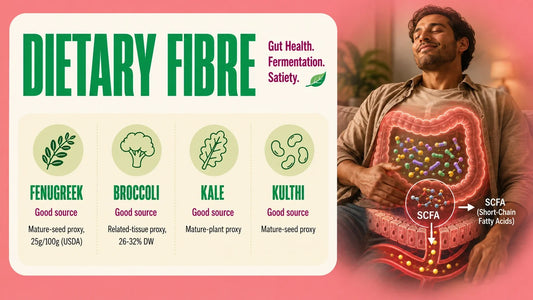
This is the part that's easy to miss, since it doesn't make for as flattering a sales pitch. USDA FoodData Central, the US government's food composition database, lists raw broccoli at roughly 2.8 g of protein and 2.6 g of dietary fibre per 100 g. Microgreen studies, including the ones already cited here, are almost entirely focused on vitamins, minerals, and antioxidant compounds rather than fibre and protein, and that's not an oversight. Microgreens are harvested at the cotyledon stage, before the plant has built out the structural cell walls and stored protein reserves that come with maturity. There simply isn't much fibre or protein there yet to measure.
This matters more than the raw numbers suggest, because of serving size. Nutrient comparisons in these studies are almost always expressed per 100 g fresh weight, but nobody eats 100 g of microgreens in one sitting. That's a large double handful. A typical serving used as a garnish or a sandwich topper is closer to 10 to 20 g. A typical serving of cooked broccoli, on the other hand, easily runs to 100 g or more. So even where microgreens win on a per-gram basis, the realistic total nutrient intake from a normal serving often favours the vegetable simply because you eat so much more of it.
This is the honest version of the comparison: microgreens concentrate certain nutrients into a very small amount of food. Mature vegetables deliver a broader, bulkier nutritional package, including the fibre and protein microgreens haven't developed yet. Neither wins outright. They're doing different jobs.
A Comparison the Nutrient Tables Don't Capture: How the Crop Was Grown
Everything so far compares nutrients gram for gram, but there's a dimension none of those tables capture: how the vegetable was actually grown before it reached your kitchen. FSSAI's own monitoring data, reported to the Rajya Sabha in August 2025, found that 2.8% of 86,401 food samples tested nationally between 2022 and 2025 exceeded the Maximum Residue Limits that the FSSAI has set for pesticides. A separate national monitoring programme run through ICAR found detectable pesticide residues in 28% of vegetable samples tested, with 3.5% exceeding those limits.
So what does this mean and what does it not?
The findings together do not suggest evidence that most vegetables in Indian markets are unsafe to eat. However, it is a genuinely different consideration from nutrient density, and one worth being honest about.
An open-field vegetable crop is exposed to weeds, field pests, and fungal disease pressure that an indoor crop never encounters, which is a large part of why open-field agriculture generally needs pesticides to protect its yield in the first place. A 2025 peer-reviewed life-cycle assessment put an actual number on that gap – researchers modelling lettuce production found open-field cultivation in California used up to 0.94 grams of pesticide per kilogram of lettuce harvested, while indoor hydroponic production was modeled as needing none at all, precisely because it was never exposed to the pressures a field crop has to be protected against. The same study found indoor growing has a higher energy footprint than open-field farming, so this isn't a case for indoor growing being better across the board, just a specific, quantified difference on this one point.
However, this should assure you of one thing – AgriZen's own microgreens are never sprayed with pesticides for two reasons:
i) They do not fall prey to the pests which crops grown in open fields are susceptible to - so there is no need to keep them away in the first place
ii) The microgreens are harvested within 1-3 weeks of sowing - so the harvesting time for the microgreens is earlier than the time at which pesticides usually get sprayed on standing crops in open fields.
Where This Leaves Microgreens in an Indian Diet
The ICMR-National Institute of Nutrition's Dietary Guidelines for Indians (2024), India's official government dietary guidance released by the Indian Council of Medical Research, updated its food-group framework for the first time to explicitly recognize microgreens as a distinct, nutrient-dense food category, describing them as young, tender plants that concentrate micronutrients and bioactive plant compounds into a small amount of food. That's a meaningful shift. It's the same food-group structure that guides national nutrition policy now naming microgreens specifically, rather than lumping them in with leafy greens generally.
What it isn't, and what we're careful not to imply, is a claim that microgreens treat or prevent any specific health condition. The recognition is about nutrient density and food-group classification, not medical claims, and that's how we'll always frame it here too.
So, Are Microgreens Worth It?
Based on everything above, the answer is yes, as an addition. The case is strongest for vitamin C, vitamin E, vitamin K, and beta-carotene, where several varieties show a real and sometimes dramatic edge over their mature form. The case is weaker and more variety-dependent for minerals. And for fibre, protein, and overall food volume, mature vegetables aren't replaced by microgreens, and were never going to be, given how early in the plant's life they're harvested.
The practical version of this: keep eating your regular vegetables for bulk, fibre, and protein, and treat microgreens as a concentrated top-up. Think of them as a way to add a meaningful amount of specific vitamins and plant compounds to a meal without adding much volume or many calories. That's a genuinely useful role. It's just a different one from "replace your vegetables," which nobody serious is actually claiming, whatever the marketing around this category sometimes implies.
Frequently Asked Questions
Do microgreens really have more vitamins than regular vegetables?
For several key vitamins, often yes, though how much depends heavily on the variety. Red cabbage microgreens show a large, well-documented edge over mature red cabbage. Broccoli microgreens barely edge out mature broccoli on vitamin C. See the full 2012 study for the variety-by-variety breakdown.
Can microgreens replace vegetables in my diet?
No, and they're not meant to. Mature vegetables provide fibre, protein, and sheer volume that microgreens, eaten in the small quantities people actually eat them in, can't replicate. Think addition, not substitution.
Which nutrient are microgreens genuinely best for?
Vitamin C, vitamin E, vitamin K, and beta-carotene show the most consistent and often dramatic advantages across the research. Mineral content is far more variable and depends a lot on the specific variety and growing method.
Does how microgreens are grown affect their nutrient content?
Yes. A 2023 study in Frontiers in Plant Science found that growing method (soil versus hydroponic, and the specific nutrient solution used) measurably affects mineral content especially. We go through how AgriZen specifically grows its microgreens in How Microgreens Are Grown: From Seed to Harvest.
Is it worth paying more for microgreens than for regular vegetables?
That depends on what you're buying them for. As a nutrient top-up added to meals you're already cooking, the research supports it, particularly for the vitamins covered above. As a replacement for your vegetable intake, no, they're not priced or positioned for that, and nutritionally they can't do that job. How to Cook With Microgreens: The Complete Guide has practical ideas for using them as the former.
Previous
How AgriZen Grows its Microgreens [A 10-Step Process from Cultivation to Delivery that we follow]
Next
How to Cook With Microgreens [General Tips on How to Introduce Microgreens into your Daily Diet for Better Nutrition]