Polyphenols & Antioxidants: Role in the Body, Sources & Which Microgreens Have It
Bite into an underripe banana, or take a sip of a young, tannic red wine, and the mouth puckers into that dry, chalky sensation. That's not imagination, and it's not really about sourness either. It's a direct physical reaction to the same family of plant compounds this post is about.
Polyphenols are one of those categories that sound impressively scientific and turn out to mean something fairly ordinary: they're the large family of plant compounds behind most of the flavour, astringency, and colour variation you taste and see across different herbs and greens. Coriander and basil, AgriZen's two herb-family microgreens, both happen to be particularly rich in them.
What It Is
Polyphenols are a broad family of plant compounds sharing a common structural feature: one or more aromatic rings carrying multiple hydroxyl (-OH) groups. This category includes flavonoids (which further subdivide into flavonols, flavanols, and anthocyanins, among others), phenolic acids like chlorogenic acid and rosmarinic acid, and tannins. Plants produce them partly as a defence against UV light and pests. “Antioxidant” isn't a separate category of compound so much as a shared chemical function many polyphenols perform once eaten, made possible by the same hydroxyl groups that define the family.
Role in the Body
Direct radical scavenging via hydroxyl groups
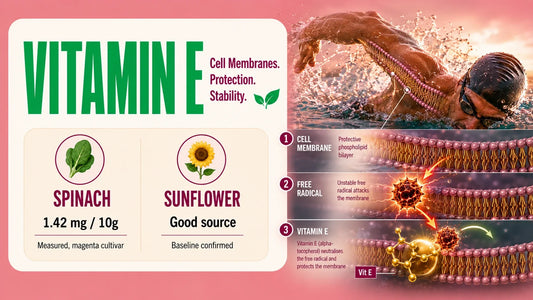
The hydroxyl groups on a polyphenol's aromatic ring can donate a hydrogen atom to a free radical, neutralising it and leaving behind a comparatively stable phenoxyl radical, a similar chemical strategy to how vitamin E intercepts lipid radicals in cell membranes. This is the best-documented mechanism behind polyphenols generally, and it's the reason they're grouped with vitamin C, vitamin E, and beta-carotene as part of the body's broader dietary antioxidant network.
Indirect activation of the Nrf2 antioxidant gene pathway
Beyond direct radical scavenging, several polyphenols, including the chlorogenic acid and rutin identified as the dominant compounds in coriander microgreens, and the rosmarinic and cichoric acid dominant in basil, can activate the Keap1-Nrf2 signalling pathway. Under normal conditions, the protein Keap1 holds Nrf2 in the cell's cytoplasm and marks it for degradation; certain polyphenols disrupt this interaction, allowing Nrf2 to move into the nucleus and switch on the transcription of the body's own antioxidant and detoxification enzymes. This means dietary polyphenols can amplify the body's internal antioxidant machinery, not just neutralise radicals on direct contact. The same signalling mechanism, and the specific Brassica compounds that trigger it, is covered in more depth in AgriZen's dedicated Sulforaphane post.
Interaction with gut bacteria
A meaningful share of dietary polyphenols aren't absorbed directly in the small intestine; instead, they reach the colon, where gut bacteria metabolise them into smaller phenolic compounds that are then absorbed and can exert their own biological effects. This is an active area of ongoing research, and specific claims about gut health benefits from any single polyphenol-rich food remain an evolving picture rather than settled science.
Food Sources (General)
Tea, coffee, dark chocolate, berries, and most herbs and spices are concentrated dietary polyphenol sources. Herbs in particular, gram for gram, are often more polyphenol-dense than fruits or vegetables, which is part of why Coriander and Basil rank as they do here. One preparation quirk worth knowing if berries are part of the picture: a 2023 study found that blending a banana into a berry smoothie can sharply cut how much flavan-3-ol, a specific polyphenol subclass found in blueberries and similar fruit, the body actually absorbs, an effect traced to an enzyme in the banana rather than anything about the berries themselves.
Which Microgreens Have It
This post links Coriander, Basil, Beetroot, and Amaranth. Coriander and Basil have real, directly measured figures from the same study, using the same methodology, Pannico et al. (2020), which makes that pair one of the more genuinely comparable tables across AgriZen's Nutrient Deep-Dive posts. Both figures required a dry-weight-to-fresh-weight conversion, shown transparently below, since the original measurement was on lyophilised (freeze-dried) samples; the study's own dry matter percentages were used for this conversion rather than a generic assumed ratio. Beetroot also has a real, direct fresh-weight figure from a separate study. Amaranth is qualitative: a real study confirms its microgreens are genuinely antioxidant-rich, but without an isolated polyphenol figure that could be extracted with confidence.
|
Microgreen |
Total Polyphenols per 10g |
Source & Notes |
|
Coriander |
Measured, this variety |
Pannico et al. (2020) measured coriander microgreens at 10,237 µg/g dry weight total polyphenols. Converting to fresh weight using the study's own dry matter data (12.8–14.0% for coriander) gives approximately 137 mg/100g FW, or roughly 13.7 mg per 10g serving. Chlorogenic acid and rutin were the two most abundant individual compounds identified. |
|
Basil |
Measured, this variety |
The same Pannico et al. (2020) study measured green basil microgreens at 13,698 µg/g dry weight, the highest of the four genotypes tested, directly comparable to coriander since both used identical methodology. Converting to fresh weight (10.1–11.9% dry matter for green basil) gives approximately 151 mg/100g FW, or roughly 15.1 mg per 10g serving. Rosmarinic acid and cichoric acid were the most abundant compounds. |
|
Beetroot |
Measured, this variety |
Balik et al. (2025) measured red beet microgreens at 373.90 mg GAE/100g FW total phenolic content, a real, direct fresh-weight figure, the lowest of six microgreens compared in that study but still a genuine, measurable contribution. |
|
Amaranth |
Good source (qualitative) |
No isolated total polyphenol figure found. A real study, Muskan et al. (2025), confirms amaranth microgreens are genuinely rich in antioxidant activity, but without a specific mg/100g polyphenol figure that could be extracted with confidence. |
There is no established Recommended Dietary Intake for polyphenols; they aren't classified as essential nutrients, so no % RDI column is included here.
Basil measured slightly higher than Coriander in the study cited, though both are genuinely high compared to the wider range of microgreens that study's authors reference from other research. Because both varieties came from the same study, same growing conditions, and same analytical method, this comparison is more apples-to-apples than most cross-study comparisons tend to be. Beetroot's figure, while real and direct, comes from a different study and methodology, so it isn't directly comparable to the Coriander-Basil pair on a like-for-like basis, even though all three are genuine measurements.
Frequently Asked Questions
Does the banana-blueberry smoothie finding mean I should stop pairing bananas with anything?
No, it's a narrow finding: it applies specifically to flavan-3-ols and specifically to blending fruit together in a way that releases the banana's polyphenol oxidase enzyme into the mix. It says nothing about eating a banana alongside coriander or basil, or about most other food pairings generally.
Are all antioxidants the same?
No. “Antioxidant” describes a function achieved through different chemistry in different compounds, direct radical donation in some cases, Nrf2 gene activation in others, and different antioxidants work in different parts of the body. A varied diet, rather than maximising any single antioxidant source, is the more evidence-based approach.
Does cooking destroy polyphenols in microgreens?
Polyphenol stability varies by specific compound structure, but many are reasonably heat-stable compared to vitamin C. Most people eat coriander and basil microgreens raw as a garnish regardless, which avoids the question entirely.
A Note on This Information
Everything above describes documented nutritional biochemistry and published research, not medical advice. Nothing on this page is a claim that any AgriZen microgreen treats, prevents, cures, or manages a medical condition. If you're managing a health condition, taking medication, pregnant, or have specific dietary needs, please check with a doctor or registered dietitian before making significant changes to your diet.
Previous
Vitamin K: Role in the Body, Sources & Which Microgreens Have It
Next
Plant Protein: Role in the Body, Sources & Which Microgreens Have It