Vitamin C: Role in the Body, Sources & Which Microgreens Have It
Reach into any Indian household's medicine drawer during flu season and there's a decent chance you'll find a strip of Limcee, or someone cutting up an orange “for the vitamin C.” That instinct isn't wrong. It's just aimed at the wrong part of the body first.
That bruise on your arm you can't remember getting, or the nimbu paani a friend swears by the moment a cold starts creeping in? Both point toward the same nutrient, though for genuinely different biochemical reasons.
Vitamin C has a branding problem: it's so strongly associated with oranges that most people never think to look for it in a tray of two-week-old greens. But ascorbic acid, its chemical name, shows up in genuinely meaningful amounts across several AgriZen varieties, sometimes at levels that beat the mature vegetable several times over.
So what's it actually doing in the body, beyond the vague promise of “immunity”? It turns out to be a specific enzyme helper working on skin, blood vessels, and gums, long before it ever touches an immune cell.
What It Is
Vitamin C, or L-ascorbic acid, is a water-soluble vitamin the human body cannot synthesise. Most other mammals produce their own ascorbic acid from glucose via the enzyme L-gulonolactone oxidase, but humans lost a functional copy of the gene encoding this enzyme at some point in primate evolution, which is why vitamin C became a dietary essential for us specifically. Because it's water-soluble, whatever the body doesn't use in a given day is excreted rather than stored, which is why vitamin C needs regular dietary top-ups rather than occasional large doses.
Role in the Body
Collagen synthesis: a required enzyme cofactor
Vitamin C is the essential cofactor for two enzymes, prolyl hydroxylase and lysyl hydroxylase, which add hydroxyl groups to the amino acids proline and lysine within newly formed collagen strands. This hydroxylation step is what allows individual collagen molecules to form the stable triple-helix structure and then cross-link into the fibres that give skin, blood vessel walls, cartilage, and bone their tensile strength. Without adequate vitamin C, hydroxylation fails, the resulting collagen is structurally weak, and it's this specific enzymatic failure that produces the connective-tissue breakdown historically seen in scurvy (Linus Pauling Institute).
A water-soluble antioxidant, and a regenerator of vitamin E
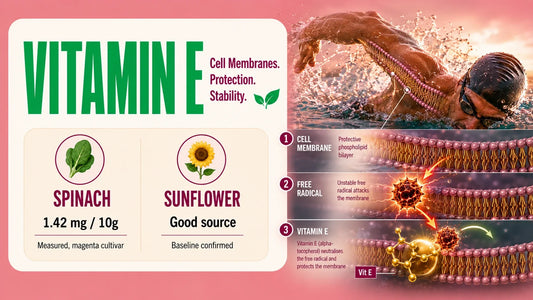
Vitamin C donates electrons to neutralise free radicals in the aqueous compartments of cells and blood plasma, complementing fat-soluble antioxidants like vitamin E and beta-carotene, which operate within cell membranes. Specifically, ascorbate can reduce the tocopheroxyl radical, the oxidised, spent form of vitamin E left behind after it has neutralised a lipid peroxyl radical, regenerating active vitamin E and extending the antioxidant chain reaction. This is a genuine biochemical partnership between the two vitamins, not just a marketing pairing.
A cofactor beyond collagen: carnitine, catecholamines, and peptide hormones
Vitamin C also acts as a cofactor for enzymes involved in the biosynthesis of carnitine, the molecule that shuttles fatty acids into mitochondria for energy production, and in the synthesis of catecholamines including norepinephrine, via the enzyme dopamine beta-hydroxylase. Separately, a vitamin C-dependent enzyme called peptidylglycine alpha-amidating monooxygenase carries out the final activation step for several peptide hormones and neurotransmitters, including oxytocin and vasopressin, by adding an amide group to their C-terminus.
Enhancing non-heme iron absorption
This is a genuinely practical, everyday mechanism: vitamin C reduces dietary non-heme iron (Fe3+) to the ferrous form (Fe2+), which is more soluble and more readily transported across the intestinal wall by the iron transporter DMT1. Pairing a vitamin C source with an iron source at the same meal is a well-documented way to improve iron uptake from plant-based food, covered in more depth in AgriZen's dedicated Iron post.
Immune cell function
White blood cells actively transport and accumulate vitamin C at concentrations many times higher than blood plasma. Once inside, it supports several of their normal functions, including chemotaxis (movement toward sites of infection or injury) and the oxidative mechanisms neutrophils use to destroy pathogens, while also protecting the immune cells themselves from the oxidative burst they generate.
Food Sources (General)
Citrus fruits are the obvious source, but amla (Indian gooseberry) is dramatically higher in vitamin C than most citrus, gram for gram, and is widely available across Delhi NCR. Guava, bell peppers, and members of the Brassica family (broccoli, cabbage, cauliflower) at maturity are also strong sources. Because ascorbic acid degrades with heat, light, and storage time, raw or lightly cooked preparations retain more of it.
Which Microgreens Have It
Kale has the strongest evidence here: a real, measured number from Vučetić et al. (2025), and it also topped a separate four-way Brassica comparison from de la Fuente et al. (2019). Broccoli and Mustard are both genuinely good sources, ranked consistently across two different studies even without a single portable mg figure between them; Mustard was lowest of the four Brassica microgreens compared, but still within the range that study's authors judged high enough to meet the EU's regulatory threshold for a “high vitamin C” nutritional claim. Bok Choy's figure is a literature-compiled range rather than one controlled study. Sango Radish is the most interesting case: one real study has it losing to kale head-to-head, while a separate seven-microgreen comparison ranks it first overall, with absolute values several times higher across the board. Both are genuine, peer-reviewed findings that simply don't agree, most likely because ascorbic acid content in microgreens varies substantially with growing medium, light exposure, and harvest timing between studies.
|
Microgreen |
Vitamin C per 10g |
% of Adult RDI* |
Source & Notes |
|
Kale |
6.61 mg |
~8–10% |
Vučetić et al. (2025) measured 66.06 mg/100g in a direct kale-vs-Sango Radish comparison; also highest of four Brassica microgreens in de la Fuente et al. (2019). |
|
Broccoli |
Good source (qualitative) |
n/a |
Ranked second of four in de la Fuente et al. (2019), and second of seven in Gunjal et al. (2024). |
|
Mustard |
Good source (qualitative) |
n/a |
Lowest of four Brassica microgreens in de la Fuente et al. (2019), but still meeting the EU's regulatory “high vitamin C” threshold. |
|
Bok Choy |
3.5–5.27 mg* |
~4–6% |
*Literature-compiled range, not one controlled study; ranked fifth of seven in Gunjal et al. (2024). |
|
Sango Radish |
2.13 mg* |
~2–3%* |
*Vučetić et al. (2025) measured 21.31 mg/100g (behind kale); Gunjal et al. (2024) ranked it first of seven overall, at 177–256 mg/100g across the group. Two real studies that disagree in scale and ranking. |
*RDI used: 80 mg/day (adult men), 65 mg/day (adult women), per ICMR-NIN 2020 Recommended Dietary Allowances for Indians. Percentages are approximate.
Frequently Asked Questions
Amla has far more vitamin C than any microgreen here. Why bother with microgreens for this nutrient at all?
Amla wins on concentration, no contest. But it's not something most people eat daily in meaningful quantity, while a microgreen garnish is something you can add to almost any meal without changing your routine. Think of Kale or Sango Radish as a small, consistent top-up alongside amla or citrus, not a replacement for either.
Does cooking destroy the vitamin C in microgreens?
Vitamin C is heat-sensitive and water-soluble, so cooking reduces it more than it does other nutrients like beta-carotene, through simple thermal degradation and leaching into cooking water. Most people eat microgreens raw as a garnish, which avoids this loss.
Why do two studies disagree on Sango Radish's vitamin C content?
Ascorbic acid content in microgreens varies substantially with growing medium, light exposure, harvest timing, and cultivar, so different studies growing the same named variety under different conditions can report meaningfully different absolute numbers. This is a known source of variability in microgreen nutrition research generally, not a sign that one study is wrong.
A Note on This Information
Everything above describes documented nutritional biochemistry and published research, not medical advice. Nothing on this page is a claim that any AgriZen microgreen treats, prevents, cures, or manages a medical condition. If you're managing a health condition, taking medication, pregnant, or have specific dietary needs, please check with a doctor or registered dietitian before making significant changes to your diet.
Previous
Pink Radish Microgreens: Taste, Nutrition & How to Use Them
Next
Iron: Role in the Body, Sources & Which Microgreens Have It