Broccoli Microgreens: Taste, Nutrition & How to Use Them
Broccoli microgreens get described as high in sulforaphane constantly, and that's not quite precise. Fresh broccoli microgreens mainly contain glucoraphanin, a stable compound that only converts into sulforaphane once the plant's cells are damaged, by chewing, chopping or crushing, through the action of an enzyme called myrosinase. It's a small distinction with a real practical consequence: how you prepare broccoli microgreens changes how much sulforaphane you actually end up with, which is worth knowing before assuming a spoonful straight from the tray delivers the full effect.
Broccoli sits in the Brassica family, alongside Mustard, Kale and Kohlrabi. This guide covers what broccoli microgreens actually are, what's genuinely in them, and how preparation affects what you get out of them. For the basics on what separates a microgreen from a sprout or a baby green in the first place, start with What Are Microgreens? A Complete Guide to Nature's Smallest, Most Concentrated Greens, our reference page for everything else on this blog.
What Is a Broccoli Microgreen?
Broccoli microgreens come from Brassica oleracea var. italica, the same plant grown for broccoli heads. The leaves are small, pale to medium green, with a flavour that's recognisably broccoli but noticeably milder and less bitter than the mature vegetable, closer to a gentle, slightly peppery green than to a floret.
Grown to microgreen size, broccoli is typically ready in eight to ten days.
Nutrient Profile
A 2023 peer-reviewed human feeding study, published in the journal Foods, gave eleven healthy participants a single serving of fresh broccoli microgreens and tracked what happened next. It confirmed broccoli microgreens carry glucoraphanin levels similar to broccoli sprouts, and that sulforaphane metabolites showed up in participants' urine and, for the first time in this kind of study, in stool samples too (full study here). That's a genuinely useful, human-level confirmation that the conversion from glucoraphanin to sulforaphane does happen after eating broccoli microgreens, not just in a lab dish.
The same study gives us something rarer still: precise yield figures, measured in actual people rather than a test tube. Broccoli microgreens contained approximately 12.8 to 13.6 µmol of glucoraphanin per gram fresh weight, comparable to broccoli sprouts (typically around 16.6 µmol/g). After chewing and digestion, urinary recovery of sulforaphane metabolites averaged around 50.5 µmol from a 16g serving - a serving that theoretically delivered roughly 100 µmol of potential sulforaphane equivalent before absorption losses, giving a real-world bioavailability of around 50%. These are more grounded numbers than the widely repeated "10 to 100 times more than mature broccoli" claim, which traces back to the original 1997 broccoli-sprout work and was never specifically about microgreens.
On general nutrition, the same peer-reviewed comparative study of four Brassica microgreens we've cited for Mustard also tested broccoli directly, finding vitamin C in the range of 31 to 56 mg per 100g fresh weight and total carotenoids of 162 to 224 mg beta-carotene per 100g dry weight (full study here).
|
Nutrient / Compound |
Level in Broccoli Microgreens |
Also Notable For |
|
Glucoraphanin (sulforaphane precursor) |
Rich source (~12.8–13.6 µmol/g FW) |
Converts to active sulforaphane only when chewed, chopped or crushed; confirmed in humans by Bouranis et al. (2023) |
|
Vitamin C |
Good source |
Comparable to other Brassica microgreens tested by de la Fuente et al. (2019) |
|
Vitamin E |
Present |
Common across Brassica microgreens |
|
Vitamin K |
Present |
Worth noting if you're on blood-thinning medication that requires consistent vitamin K intake |
Ratings above are qualitative rather than a single fixed figure, since values shift with growing conditions, harvest age and preparation method, and in this case, preparation matters more than usual.
None of this amounts to a claim that broccoli microgreens treat, prevent or manage any named health condition. Sulforaphane is an active area of laboratory and early human research, but that research doesn't translate into a promise about any specific outcome. They're a nutrient-dense addition to a meal.
Role in the Body
Broccoli is a good source of vitamin C, a water-soluble vitamin involved in collagen formation, wound repair and immune function. We cover vitamin C in more depth, including how broccoli compares to other AgriZen varieties, in Vitamin C: Role in the Body, Sources & Which Microgreens Have It, our dedicated nutrient deep-dive.
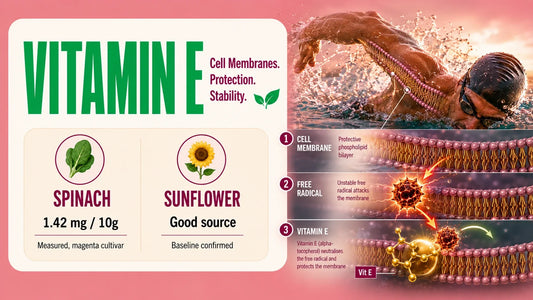
It also carries vitamin E, a fat-soluble antioxidant, and vitamin K, best known for its role in blood clotting. We cover both in more depth in Vitamin E: Role in the Body, Sources & Which Microgreens Have It and Vitamin K: Role in the Body, Sources & Which Microgreens Have It, our dedicated nutrient deep-dives.
As covered above, glucoraphanin's conversion to sulforaphane depends on the myrosinase enzyme, which is released when the plant is chewed, chopped or crushed, and is heat-sensitive, meaning thorough cooking reduces how much of it survives to do the converting.
How to Use Broccoli Microgreens
Broccoli's mild flavour holds up well in warm dishes without disappearing entirely, and giving it a rough chop before adding it, rather than leaving it whole, helps activate more of its glucoraphanin-to-sulforaphane conversion in the process.
There's a useful practical tip worth knowing if you cook broccoli microgreens rather than eat them raw: adding a small amount of an external myrosinase source alongside them can substantially rescue the sulforaphane yield that cooking would otherwise destroy. A randomised crossover trial in Molecular Nutrition & Food Research, involving 12 healthy adults, found that adding just 1g of powdered brown mustard seed to cooked broccoli raised urinary sulforaphane recovery from 9.8 to 44.7 µmol - more than a fourfold increase (full study here). The mechanism is straightforward: heat denatures the plant's own myrosinase; mustard seed supplies active myrosinase from an external source to replace it. Daikon radish and raw rocket contain myrosinase too. This applies when broccoli microgreens are heated; raw microgreens retain their own myrosinase intact and don't need the pairing.
A Quick Growing Note
AgriZen grows every variety the same way, indoors under LED light, watered with RO-purified water, from certified organic seed. We cover that full process, and what the organic-seed certification does and doesn't cover, in How Microgreens Are Grown: From Seed to Harvest.
Frequently Asked Questions
What do broccoli microgreens taste like?
Recognisably broccoli, but noticeably milder and less bitter than the mature vegetable, closer to a gentle, slightly peppery green.
Do broccoli microgreens actually contain sulforaphane?
Fresh, mostly not yet - they contain glucoraphanin, a precursor that converts into sulforaphane when the plant tissue is damaged by chewing, chopping or crushing. A 2023 peer-reviewed human study confirmed sulforaphane metabolites do show up after eating broccoli microgreens, so the conversion genuinely happens, it just isn't sulforaphane sitting in the leaf waiting to be eaten.
Does cooking destroy the benefit of broccoli microgreens?
Not entirely, but thorough cooking denatures the myrosinase enzyme responsible for converting glucoraphanin into sulforaphane, so less of it forms. Chopping before a brief, light cooking - or adding a small amount of mustard seed alongside them - preserves more of the conversion than long, high-heat cooking.
What's the mustard-seed pairing about?
Mustard seeds contain active myrosinase, the same enzyme broccoli uses to convert glucoraphanin into sulforaphane. When broccoli is cooked, its own myrosinase is destroyed; adding a small amount of raw mustard seed restores the conversion. A human feeding trial found this boosted sulforaphane recovery more than fourfold.
Which other AgriZen microgreens pair well with broccoli?
Within the Brassica family, Mustard, Kale and Kohlrabi share a similar growing profile, though each has its own distinct flavour, from mustard's sharp heat to kale's earthiness.
How long do broccoli microgreens keep after delivery?
Like any fresh, ready-to-eat leafy product, they're best eaten within a few days of delivery and should be kept refrigerated in the meantime. For the full storage guidance, see How to Store Microgreens at Home to Make Them Last Longer.
A Small, Precise Addition
Broccoli microgreens are a good example of why precision matters in nutrition writing - the compound everyone's interested in isn't quite sitting in the leaf the way it's often described, and how you prepare it genuinely changes what you get. A rough chop before eating, and a pinch of mustard seed when cooking, are small habits that make a real difference. Grown indoors under LED light on AgriZen's shelving, watered with RO-purified water, and cut fresh to order.
Previous
Choosing the Right AgriZen Subscription [Which One Is the Right Option for You?]
Next
Wheatgrass Microgreens: Taste, Nutrition & How to Use Them