Wheatgrass Microgreens: Taste, Nutrition & How to Use Them
Wheatgrass gets marketed as gluten-free often enough that it's worth being precise about why, and where that claim can break down. Gluten protein is concentrated in the wheat seed, not the young grass blade, and wheatgrass is harvested well before the plant sets seed, so the grass itself genuinely doesn't contain much gluten. But the National Celiac Association notes it's very difficult to guarantee wheat grass is completely free of contact with seed during growing or processing, which is why the FDA's under-20-parts-per-million gluten-free labelling threshold still matters (source). If gluten is a concern for you or someone you're feeding, the safe move is to check for a specifically tested and labelled gluten-free product rather than assuming any wheatgrass qualifies by default.
Wheatgrass sits in the Grain & Seed family, alongside Oats, Sunflower and Flax. This guide covers what wheatgrass actually is, what's genuinely in it, and how it's used differently from every other microgreen on this list. For the basics on what separates a microgreen from a sprout or a baby green in the first place, start with What Are Microgreens? A Complete Guide to Nature's Smallest, Most Concentrated Greens, our reference page for everything else on this blog.
What Is Wheatgrass?
Wheatgrass comes from Triticum aestivum, the same species grown for wheat grain, but harvested as the young grass blade rather than the seed head. It grows as a dense mat of thin, upright green blades rather than the paired seed-leaf shape most microgreens have, since grasses don't produce true leaves the same way broad-leaved plants do.
This is also the one variety on this list that's genuinely different in how it's eaten. Wheatgrass's fibrous cell walls are tough enough that most people can't chew and digest it comfortably, which is why it's almost always juiced rather than eaten whole, unlike every other microgreen AgriZen grows. The juice itself has a sweet, intensely grassy flavour.
Grown to harvest size, wheatgrass is typically ready in seven to ten days.
What Is Wheatgrass?
Wheatgrass comes from Triticum aestivum, the same species grown for wheat grain, but harvested as the young grass blade rather than the seed head. It grows as a dense mat of thin, upright green blades rather than the paired seed-leaf shape most microgreens have, since grasses don't produce true leaves the same way broad-leaved plants do.
This is also the one variety on this list that's genuinely different in how it's eaten. Wheatgrass's fibrous cell walls are tough enough that most people can't chew and digest it comfortably, which is why it's almost always juiced rather than eaten whole, unlike every other microgreen AgriZen grows. The juice itself has a sweet, intensely grassy flavour.
Grown to harvest size, wheatgrass is typically ready in seven to ten days.
Nutrient Profile
A 2024 systematic review of wheatgrass and pulse microgreens, published in the peer-reviewed journal eFood, compiled mineral data across multiple studies and growing methods. Across soil, nutrient-solution and water-grown wheatgrass, potassium ranged from 3.09 to 9.57 g/kg, iron from 0.45 to 1.56 g/kg, calcium from 0.44 to 2.99 g/kg, magnesium from 0.71 to 1.64 g/kg, and phosphorus from 2.60 to 6.24 g/kg (full study here). The review found soil-grown wheatgrass tended to run higher in magnesium, potassium, calcium and manganese, while water or nutrient-solution-grown wheatgrass tended to run higher in phosphorus, iron and copper.
On chlorophyll specifically, we can go beyond a qualitative claim: a peer-reviewed compositional analysis of lyophilised wheatgrass juice powder measured chlorophyll at 7.46 mg per gram (full study here), broadly consistent with other published figures in the 391 to 514 mg per 100 g range depending on whether the measurement is on fresh juice or dried powder. That intensity of chlorophyll is precisely why wheatgrass juice is used in small shot-sized servings rather than larger volumes.
On antioxidant activity: a 2025 peer-reviewed phytochemical evaluation, published in Discover Food, measured wheatgrass extract at a DPPH IC50 of 20.21 micrograms per millilitre (a lower number means stronger antioxidant activity), total phenolic content of 32.41 mg gallic acid equivalents per gram, and total flavonoids of 48.04 mg rutin equivalents per gram (full study here). A separate comparative study on juicing found wheatgrass juice carried the highest total and bioaccessible calcium, magnesium, manganese, iron and zinc, and the highest total phenolic and flavonoid content, of several fruit and vegetable juices tested (full study here), which is a useful, sourced reason juicing concentrates these compounds rather than diluting them, though it's worth noting juicing also removes the insoluble fibre that stays behind in the pulp.
|
Nutrient / Compound |
Level in Wheatgrass |
Also Notable For |
|
Chlorophyll |
Rich source - ~7.46 mg/g in lyophilised juice powder |
Gives the juice its intense colour; concentrated further by juicing |
|
Total Phenolics & Flavonoids |
Rich source - TPC 32.41 mg GAE/g, flavonoids 48.04 mg RE/g |
DPPH antioxidant activity IC50 20.21 mcg/mL |
|
Potassium, Calcium, Magnesium |
Present, higher in soil-grown batches |
Per Kumar et al. (2024) systematic review |
|
Iron, Copper |
Present, higher in water or nutrient-solution-grown batches |
Wheatgrass juice shown to have the highest bioaccessible iron of several juices compared |
|
Zinc, Manganese |
Present |
Levels vary significantly by growing method |
Ratings above are qualitative rather than a single fixed figure, since mineral levels shift meaningfully with growing method, harvest age and analysis method, more so for wheatgrass than for most other microgreens AgriZen grows.
None of this amounts to a claim that wheatgrass treats, prevents or manages any named health condition, and we'd flag that wheatgrass in particular attracts some of the boldest health claims of any microgreen online, most of them well beyond what the evidence supports. It's a nutrient-dense addition to a diet, not a treatment for anything specific.
Role in the Body
Wheatgrass's most distinctive feature is its chlorophyll content, the pigment responsible for its saturated green colour. In the body, chlorophyll and its derivatives are studied mainly for antioxidant activity. We go through chlorophyll in more depth, including how wheatgrass compares to other green AgriZen varieties, in Chlorophyll: Role in the Body, Sources & Which Microgreens Have It, our dedicated nutrient deep-dive.
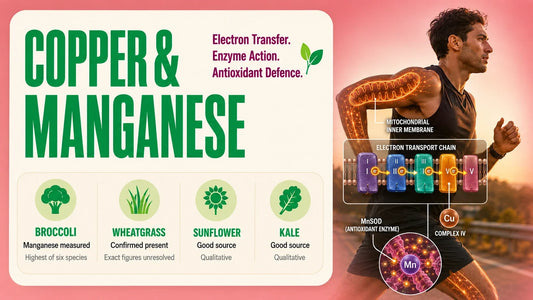
Wheatgrass also carries zinc, a mineral involved in immune function and wound healing, alongside copper and manganese, both of which act as cofactors for enzymes involved in antioxidant defence and metabolism. We cover these in more depth in Zinc: Role in the Body, Sources & Which Microgreens Have It and Copper & Manganese: Role in the Body, Sources & Which Microgreens Have It, our dedicated nutrient deep-dives.
How to Use Wheatgrass
Because of its fibrous texture, wheatgrass is almost always juiced rather than eaten as a leaf, which makes it the one variety on this blog that doesn't really fit into a sandwich, salad or garnish. A small shot, often blended with fruit to soften the intensity of the flavour, is the standard serving size.
A Quick Growing Note
AgriZen grows every variety the same way, indoors under LED light, watered with RO-purified water, from certified organic seed. We cover that full process, and what the organic-seed certification does and doesn't cover, in How Microgreens Are Grown: From Seed to Harvest.
The one thing that's genuinely different about wheatgrass is that, like sunflower, it benefits from a weighted tray during the blackout period, which helps the blades grow upright and even rather than curling.
Frequently Asked Questions
What does wheatgrass taste like?
Sweet and intensely grassy, strong enough that it's almost always blended with fruit or diluted rather than taken on its own.
Is wheatgrass gluten-free?
Usually, but not automatically. Gluten protein sits in the wheat seed, and wheatgrass is harvested before the seed forms, so the grass itself is naturally low in gluten. The risk is contact with seed during growing or processing.
Does juicing wheatgrass lose nutrients compared to eating it whole?
Not really, if anything the opposite for minerals and antioxidants specifically. A comparative study found wheatgrass juice carried the highest bioaccessible minerals and phenolic content of several juices tested. What juicing does remove is the insoluble fibre, which stays in the pulp.
Why is wheatgrass usually juiced instead of eaten like other microgreens?
Its cell walls are fibrous enough that most people can't comfortably chew or digest it whole. Juicing extracts the nutrients and flavour without the tough fibre.
Which other AgriZen microgreens pair well with wheatgrass?
Within the Grain & Seed family, Oats, Sunflower and Flax share a similar growing profile, though wheatgrass is the only one typically juiced rather than eaten as a leaf.
How long does wheatgrass keep after delivery?
Like any fresh, ready-to-eat leafy product, it's best used within a few days of delivery and should be kept refrigerated in the meantime. For the full storage guidance, see How to Store Microgreens at Home to Make Them Last Longer.
A Small Shot of Green
Wheatgrass is the one variety on this blog that breaks the mould, grown and used differently from every leafy or peppery microgreen around it, and worth approaching with a clear head about what the evidence does and doesn't say, given how much folklore surrounds it. Grown indoors under LED light on AgriZen's shelving, watered with RO-purified water, and cut fresh to order, it's best enjoyed the way it's traditionally used: a small, intense shot rather than a garnish.
Previous
Broccoli Microgreens: Taste, Nutrition & How to Use Them
Next
Sunflower Microgreens: Taste, Nutrition & How to Use Them