Fenugreek Microgreens: Taste, Nutrition & How to Use Them
Eating fenugreek can make sweat and urine smell like maple syrup, and it's worth knowing in advance rather than discovering it and worrying. The compound responsible, sotolon, passes through the body largely unchanged and is excreted in sweat and urine. Peer-reviewed research has confirmed sotolon is the same compound behind the characteristic odour of maple syrup urine disease, a serious inherited metabolic disorder, which has led to documented cases of breastfed infants being mistakenly flagged for that condition after their nursing mother had been eating fenugreek (full study here). It's a harmless, temporary effect on its own, just one worth recognising for what it is.
Fenugreek sits in the Legume family, alongside Affilia Pea, Kulthi and Alfalfa. This guide covers what fenugreek microgreens actually are, what's genuinely in them, and how they fit into a meal. For the basics on what separates a microgreen from a sprout or a baby green in the first place, start with What Are Microgreens? A Complete Guide to Nature's Smallest, Most Concentrated Greens, our reference page for everything else on this blog.
What Is a Fenugreek Microgreen?
Fenugreek microgreens come from Trigonella foenum-graecum, the same plant used as both a seed spice and a leafy herb across Indian, Middle Eastern and Mediterranean cooking. The leaves are small and rounded, with a flavour that's distinctly bitter and aromatic, milder than the mature herb but recognisably the same plant, close to the flavour that gives many dals and curries their characteristic edge.
Because the seed has a hard coat similar to Affilia Pea's, fenugreek is usually soaked for several hours before sowing to even out germination. Grown to microgreen size, it's typically ready in eight to twelve days.
Nutrient Profile
A 2020 peer-reviewed study out of King's College London, published in the journal Nutrients, compared iron content and absorption between mature and microgreen fenugreek, rocket and broccoli. The finding is more nuanced than a simple "microgreens win" story: mature fenugreek actually contained more total iron and more of it was bioaccessible than in the microgreen form. But fenugreek microgreens specifically showed significantly higher iron uptake in intestinal cell models than the mature vegetable did, the only one of the three plants tested where the microgreen stage outperformed the mature stage on that specific measure (full study here). We're leading with this because it's a more honest picture than the blanket "more nutrient-dense" framing that circulates widely.
Two other compounds in fenugreek are worth naming specifically, since they're documented in the plant and relevant to the microgreen stage. The first is trigonelline, an alkaloid measured at 5.22 to 13.65 mg per gram across 31 fenugreek genotypes studied (full study here). Trigonelline is what's responsible for some of fenugreek's characteristic bitterness, and when heated it partially converts to niacin (vitamin B3). A 2024 metabolomics study specifically on fenugreek microgreens confirmed trigonelline is present at the microgreen stage alongside other alkaloids (full study here).
The second is diosgenin, a steroidal saponin found in fenugreek seed and leaves. In a comparison of eleven Indian fenugreek varieties across seed, sprout and tender leaf stages, diosgenin in tender leaves reached 466.89 mg per 100 g fresh weight in one variety -- the highest of any stage tested (full study here). While that figure is for mature tender leaves rather than microgreens specifically, it establishes that young leaf tissue is a meaningful diosgenin source. Diosgenin has a long history of interest in pharmaceutical and food research.
On zinc specifically: a 2025 study across 30 fenugreek genotypes at the sprout stage found zinc as high as 54.44 mg per 100 g in the highest-zinc genotype (full study here). This is a genotype and sprout-stage figure, not a standard microgreen measurement, but it indicates zinc is meaningfully present across the fenugreek plant's early growth stages.
|
Nutrient / Compound |
Level in Fenugreek Microgreens |
Also Notable For |
|
Iron |
Present - lower total content than mature fenugreek but more efficiently absorbed |
Microgreen stage outperformed mature fenugreek on cellular iron uptake in Khoja et al. (2020) |
|
Trigonelline (alkaloid) |
Present at the microgreen stage - 5.22-13.65 mg/g across genotypes |
Contributes to fenugreek's bitterness; converts partially to niacin on heating; confirmed in fenugreek microgreens by metabolomics |
|
Diosgenin (steroidal saponin) |
Present |
Young fenugreek leaf tissue shows meaningful diosgenin content (466.89 mg/100g FW in one variety's tender leaves) |
|
Zinc |
Present - up to 54.44 mg/100g in sprouts of high-zinc genotypes |
Common across Legume family microgreens; value varies significantly by genotype |
|
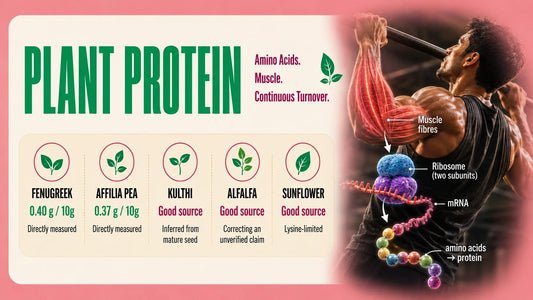
Plant Protein |
Present |
Carried over from the seed, shared with Affilia Pea, Kulthi and Alfalfa |
Ratings above are qualitative. Trigonelline and zinc figures are from seed/genotype and sprout-stage studies; diosgenin is from mature tender leaf data. These are the closest published proxies for the microgreen stage.
None of this amounts to a claim that fenugreek microgreens treat, prevent or manage any named health condition. They're a nutrient-dense addition to a meal, best eaten as part of a varied diet.
Role in the Body
Fenugreek's most relevant mineral is iron, central to how the body transports oxygen through the blood. As covered above, the picture is more nuanced than usual for this variety, worth reading in full rather than assuming more concentrated automatically means better absorbed. We go through iron in more depth in Iron: Role in the Body, Sources & Which Microgreens Have It, our dedicated nutrient deep-dive.
Fenugreek also carries zinc, a mineral involved in immune function and wound healing, and plant protein, which plays a role in muscle repair and enzyme function. We cover both in more depth in Zinc: Role in the Body, Sources & Which Microgreens Have It and Plant Protein: Role in the Body, Sources & Which Microgreens Have It, our dedicated nutrient deep-dives.
How to Use Fenugreek Microgreens
Fenugreek's bitter, aromatic edge holds up well steeped in hot water as much as scattered over a dish, which makes it one of the more versatile microgreens for uses beyond the usual sandwich or garnish. The trigonelline that contributes to its bitterness also partially converts to niacin when heated, which makes the tea use particularly appropriate.
A Quick Growing Note
AgriZen grows every variety the same way, indoors under LED light, watered with RO-purified water, from certified organic seed. We cover that full process, and what the organic-seed certification does and doesn't cover, in How Microgreens Are Grown: From Seed to Harvest.
Frequently Asked Questions
What do fenugreek microgreens taste like?
Distinctly bitter and aromatic, milder than the mature herb but recognisably the same flavour that gives many dals and curries their edge.
Why do I smell like maple syrup after eating fenugreek?
A compound called sotolon passes through the body largely unchanged and is excreted in sweat and urine, producing a maple syrup-like scent. It's harmless and temporary, though worth recognising since the same compound is associated with a serious genetic condition, which has occasionally led to false alarm in breastfed infants of mothers eating fenugreek.
What is trigonelline and why does it matter?
Trigonelline is an alkaloid naturally present in fenugreek that contributes to its characteristic bitterness. When heated, it partially converts to niacin (vitamin B3). It's also been confirmed present at the microgreen stage by metabolomics research.
Are fenugreek microgreens richer in iron than mature fenugreek?
Not by total content -- a 2020 study found mature fenugreek had more iron and more of it was bioaccessible. But the microgreen stage showed notably better iron uptake in cell-based testing, so the comparison isn't as simple as picking whichever has the bigger number.
Which other AgriZen microgreens pair well with fenugreek?
Within the Legume family, Affilia Pea, Kulthi and Alfalfa share a similar growing profile, though each has a milder flavour than fenugreek's distinctive bitterness.
How long do fenugreek microgreens keep after delivery?
Like any fresh, ready-to-eat leafy product, they're best eaten within a few days of delivery and should be kept refrigerated in the meantime. For the full storage guidance, see How to Store Microgreens at Home to Make Them Last Longer.
A Small, Distinctive Addition
Fenugreek is a good reminder that a plant's story doesn't always follow the tidy "microgreens beat mature vegetables" pattern -- and that sometimes the more interesting compounds are the ones most people don't know about, like the trigonelline that converts to a B-vitamin on heating. Grown indoors under LED light on AgriZen's shelving, watered with RO-purified water, and cut fresh to order, fenugreek's bitter, aromatic edge makes it one of the more distinctive additions on the menu.
Previous
Coriander Microgreens: Taste, Nutrition & How to Use Them
Next
Mustard Microgreens: Taste, Nutrition & How to Use Them