Spinach Microgreens: Taste, Nutrition & How to Use Them
Mature spinach carries a well-earned caution around oxalates, the compound behind advice to limit spinach if you're prone to kidney stones. It's reasonable to assume the microgreen stage carries the same caution. It doesn't, at least not to the same degree. A 2020 peer-reviewed study found spinach microgreens had up to sixteen times less oxalate than mature spinach leaves, a big enough gap that it's worth correcting the assumption rather than letting it carry over.
Spinach sits in the Leafy & Herb family, alongside Lettuce, Coriander and Basil. This guide covers what spinach microgreens actually are, what's genuinely in them, and how they fit into a meal. For the basics on what separates a microgreen from a sprout or a baby green in the first place, start with What Are Microgreens? A Complete Guide to Nature's Smallest, Most Concentrated Greens, our reference page for everything else on this blog.
What Is a Spinach Microgreen?
Spinach microgreens come from Spinacia oleracea, the same species as mature spinach, with small, tender, rounded to oval leaves on delicate stems. The flavour is mild and grassy, recognisably spinach but without the earthy, slightly metallic edge mature leaves can carry, which is part of why it works so well blended raw rather than cooked. Compared to the faster Brassica and Legume varieties AgriZen grows, spinach takes a little longer to reach harvest size, typically ten to fourteen days.
Spinach seed has a naturally corky seed coat, which is why it's usually soaked for several hours before sowing, similar to a handful of other thicker-coated seeds AgriZen grows, to help even out germination across the tray.
Nutrient Profile
The same 2020 peer-reviewed study, published in the Journal of Food Composition and Analysis, that measured oxalate across ten culinary microgreens found spinach's oxalate content at the microgreen stage was roughly sixteen times lower than mature spinach leaves, alongside good levels of vitamin C, vitamin E and beta-carotene (full study here).
On vitamin K specifically, it's worth a correction rather than repeating an easy claim: the "magenta spinach" entry in Xiao et al. (2012), a 2012 study measuring 25 commercially grown microgreens, is actually Atriplex hortensis (orach), a different plant entirely, not true spinach (Spinacia oleracea). We don't have a genuine spinach-microgreen-specific vitamin K figure to cite, so rather than borrow a number from the wrong plant, we're presenting the mature-spinach reference point instead: raw spinach carries roughly 483 micrograms of vitamin K per 100 g, one of the richest sources documented by USDA FoodData Central, at over 400% of the daily value.
On lutein and zeaxanthin: true spinach also wasn't among the species Xiao et al. tested as a microgreen, so we don't have a spinach-microgreen figure for these either. What the same study did establish is a useful benchmark: mature spinach carries roughly 7.2 mg of lutein and zeaxanthin combined per 100 g, and several other microgreens, including cilantro, red sorrel, red cabbage and garnet amaranth, were found to exceed that figure at 8.4 to 10.1 mg per 100 g. We're presenting this as honest context rather than a spinach-specific claim.
On nitrates: spinach is a genuine nitrate-accumulating species, at both the mature and microgreen stages, and this is worth addressing directly rather than glossing over. A dedicated 2021 peer-reviewed study on spinach microgreens specifically, published in Horticulturae, found that a shorter, ten-day nutrient-solution feeding regime produced 70.7% less nitrate than a twenty-day regime, while retaining yield and quality (full study here). Growing conditions genuinely change nitrate accumulation, not just marketing language. On the health side, both the American Academy of Pediatrics and the European Food Safety Authority have flagged spinach specifically as a vegetable where nitrate advisories matter most for infants and very young children, and a documented case report describes an infant developing methemoglobinemia after formula was prepared with spinach juice. This isn't a caution about AgriZen's spinach microgreens specifically, it's a general food-safety point about the species that's worth knowing if you're feeding young children.
|
Nutrient / Compound |
Level in Spinach Microgreens |
Also Notable For |
|
Vitamin K |
Present - mature spinach reference: ~483 mcg/100g |
No verified microgreen-specific figure; the commonly cited 'magenta spinach' Xiao et al. figure is actually orach, a different plant |
|
Lutein & Zeaxanthin |
Present - mature spinach reference: ~7.2 mg/100g |
Several other microgreens (cilantro, red sorrel) documented to exceed mature spinach on this measure |
|
Vitamin A (Beta-Carotene) |
Good source |
A precursor the body converts to vitamin A |
|
Vitamin E |
Present |
Common across Leafy & Herb family microgreens |
|
Oxalic Acid (antinutrient) |
Much lower than mature spinach |
Up to 16-fold lower per Ghoora et al. (2020) |
|
Nitrate |
Present - growing regime matters |
A 10-day feeding regime cut nitrate by 70.7% vs a 20-day regime in a dedicated spinach microgreen study |
If you take a blood thinner such as warfarin, vitamin K intake consistency matters more than the absolute amount, so it's worth mentioning to whoever manages your medication that spinach, at any growth stage, is a vitamin K source.
None of this amounts to a claim that spinach microgreens treat, prevent or manage any named health condition. They're a nutrient-dense, low-oxalate addition to a meal, best eaten as part of a varied diet rather than as a stand-in for other vegetables or medical guidance.
Role in the Body
Spinach's most relevant nutrient for most people is vitamin K, a fat-soluble vitamin best known for its role in blood clotting and involved in bone metabolism as well. We go through vitamin K in more depth, including the medication-interaction point above, in Vitamin K: Role in the Body, Sources & Which Microgreens Have It, our dedicated nutrient deep-dive.
Spinach also carries beta-carotene, a plant pigment the body converts into vitamin A, a nutrient involved in vision, immune function and skin health. We cover beta-carotene and vitamin A in more depth in Vitamin A (Beta-Carotene): Role in the Body, Sources & Which Microgreens Have It, our dedicated nutrient deep-dive.
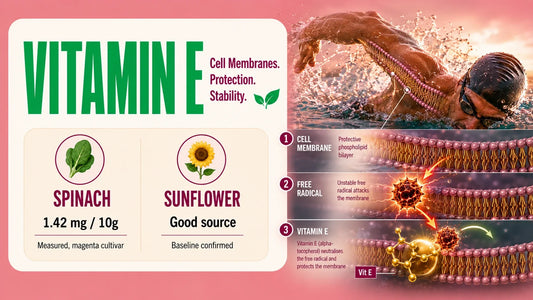
Alongside these, spinach is a source of vitamin E, a fat-soluble antioxidant that plays a role in immune function and skin health. We cover it in more depth in Vitamin E: Role in the Body, Sources & Which Microgreens Have It, our dedicated nutrient deep-dive.
How to Use Spinach Microgreens
Spinach's mild, tender leaves blend smoothly and don't fight with other flavours, which is exactly why it holds up well in something you're drinking rather than chewing, unlike sturdier or more peppery varieties.
A Quick Growing Note
AgriZen grows every variety the same way, indoors under LED light, watered with RO-purified water, from certified organic seed. We cover that full process, and what the organic-seed certification does and doesn't cover, in How Microgreens Are Grown: From Seed to Harvest.
Frequently Asked Questions
What do spinach microgreens taste like?
Mild and grassy, recognisably spinach but without the earthy, slightly metallic edge mature leaves can have.
Do spinach microgreens have the same high oxalate content as mature spinach?
No. A 2020 peer-reviewed study found spinach microgreens carried roughly sixteen times less oxalate than mature spinach leaves.
Should I worry about nitrates in spinach microgreens?
Spinach is a nitrate-accumulating species at any growth stage, and growing conditions genuinely affect the level, a dedicated study found a shorter feeding regime cut nitrate by over 70%. Health advisories on this front are mainly directed at infants and very young children; it isn't a specific caution for typical adult consumption.
Which other AgriZen microgreens pair well with spinach?
Within the Leafy & Herb family, Lettuce, Coriander and Basil share a similar growing profile and blend well alongside spinach in the same smoothie or salad.
How long do spinach microgreens keep after delivery?
Like any fresh, ready-to-eat leafy product, they're best eaten within a few days of delivery and should be kept refrigerated in the meantime. For the full storage guidance, see How to Store Microgreens at Home to Make Them Last Longer.
Can spinach microgreens be cooked?
They can, but their delicate texture wilts quickly with heat, so most of their value comes from eating them raw or adding them right at the very end of cooking.
A Small, Gentler Addition
Spinach microgreens are a good example of why growth stage matters as much as species when it comes to nutrition, and why it's worth double-checking which plant a cited figure actually refers to before repeating it. Grown indoors under LED light on AgriZen's shelving, watered with RO-purified water, and cut fresh to order, it's a mild, tender addition suited to blending as much as to eating straight.
Previous
Mustard Microgreens: Taste, Nutrition & How to Use Them
Next
Kale Microgreens: Taste, Nutrition & How to Use Them