Kale Microgreens: Taste, Nutrition & How to Use Them
Kale gets a reputation for being risky for thyroid health, because of compounds called goitrogens that can interfere with the thyroid's iodine uptake, and that reputation is worth examining rather than either dismissing or accepting wholesale. A 2016 peer-reviewed quantitative review found that common, commercially grown kale (Brassica oleracea) actually carries goitrin levels well under the threshold shown to measurably affect iodine uptake. The kale variety that does carry meaningfully higher levels is Russian kale (Brassica napus), a different, less common species (full study here). Which kale, and how much of it, turns out to matter more than the blanket "kale is a goitrogen" framing that circulates.
Kale sits in the Brassica family, alongside Mustard, Broccoli and Kohlrabi. Unlike Bok Choy, which is a different species entirely, kale genuinely is the same species as broccoli and kohlrabi, Brassica oleracea, just bred for a different shape. This guide covers what kale microgreens actually are, what's genuinely in them, and how to think about the smoothie-moderation question sensibly. For the basics on what separates a microgreen from a sprout or a baby green in the first place, start with What Are Microgreens? A Complete Guide to Nature's Smallest, Most Concentrated Greens, our reference page for everything else on this blog.
What Is a Kale Microgreen?
Kale microgreens come from Brassica oleracea, the same species as broccoli and kohlrabi. The leaves are small, tender and slightly ruffled at the edges, with a flavour that's mild and faintly earthy, a gentler, less bitter version of mature kale.
Grown to microgreen size, kale is typically ready in ten to fourteen days.
Nutrient Profile
The same peer-reviewed study of four Brassica microgreens we've referenced for Mustard and Broccoli, published in Foods, found kale carried the highest vitamin C of the four varieties tested, ahead of broccoli, mustard and radish (full study here). The study notes kale vitamin C falls in the published range of 28 to 66 mg per 100 g fresh weight for kale microgreens. Notably, the paper found kale and mustard microgreens contained less ascorbic acid than their mature counterparts -- an unusual result, since most microgreens run higher than mature vegetables on vitamin C, and one worth noting rather than glossing over.
On glucosinolates: kale is not just a goitrogen story. A peer-reviewed sprout comparison study (PMC10254352) testing broccoli, kale and radish sprouts found kale carried glucoraphanin -- the actual precursor to sulforaphane -- and in some cases outperformed broccoli cultivars on glucoraphanin and sulforaphane content (full study here). The dominant glucosinolate in kale is sinigrin, measured at roughly 55 to 66 µmol per gram dry weight in kale sprouts (full profile study here), but the presence of glucoraphanin means kale is a genuine sulforaphane source -- one of the less widely known facts about this particular Brassica.
On the goitrogen question specifically: the low goitrin levels reported for commercial kale in the 2016 review were measured in the mature vegetable, not the microgreen. Separate research on Brassica microgreens has found glucosinolate content can run higher in microgreens than in mature leaves for some varieties. We don't have a kale microgreen-specific goitrin figure we're confident citing, so we're not claiming the mature-kale reassurance carries over directly. In practical terms, a microgreen garnish is a much smaller serving than a daily blended cup of packed leaves.
|
Nutrient / Compound |
Level in Kale Microgreens |
Also Notable For |
|
Vitamin C |
Rich source - highest of 4 Brassica microgreens tested |
28-66 mg/100g FW range; de la Fuente et al. (2019) note kale/mustard microgreens may be lower than their mature counterparts on this measure |
|
Glucoraphanin (sulforaphane precursor) |
Present |
Kale matched or exceeded some broccoli cultivars on glucoraphanin and sulforaphane content in a direct sprout comparison (PMC10254352) |
|
Sinigrin (dominant glucosinolate) |
Rich source - ~55-66 µmol/g DW in kale sprouts |
Sinigrin is the dominant glucosinolate; breaks down to allyl isothiocyanate, the same compound as in mustard |
|
Vitamin A (Beta-Carotene) |
Good source |
A precursor the body converts to vitamin A |
|
Vitamin E |
Present |
Common across Brassica microgreens |
Ratings above are qualitative rather than a single fixed figure, since values shift with growing conditions, harvest age and analysis method.
None of this amounts to a claim that kale microgreens treat, prevent or manage any named health condition, or that they pose a specific risk to thyroid function at normal serving sizes. They're a nutrient-dense addition to a meal, best eaten as part of a varied diet.
Role in the Body
Kale is a strong source of vitamin C, involved in collagen formation, wound repair and immune function. We cover vitamin C in more depth, including how kale compares to other AgriZen varieties, in Vitamin C: Role in the Body, Sources & Which Microgreens Have It, our dedicated nutrient deep-dive.
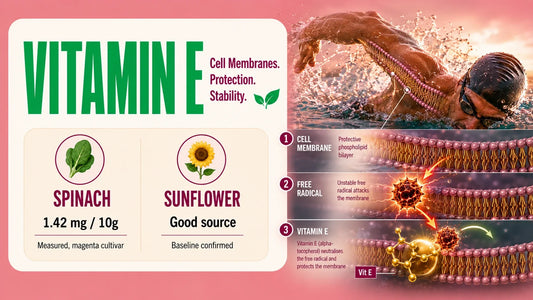
It also carries beta-carotene, a precursor the body converts to vitamin A, and vitamin E, a fat-soluble antioxidant. We cover both in more depth in Vitamin A (Beta-Carotene): Role in the Body, Sources & Which Microgreens Have It and Vitamin E: Role in the Body, Sources & Which Microgreens Have It, our dedicated nutrient deep-dives.
How to Use Kale Microgreens
Kale's mild, earthy flavour blends smoothly without turning bitter, which is exactly why it holds up well in something you're drinking, and it's worth remembering that a microgreen garnish is a much smaller serving than a packed cup of mature leaves if you're the type to blend a daily green smoothie.
A Quick Growing Note
AgriZen grows every variety the same way, indoors under LED light, watered with RO-purified water, from certified organic seed. We cover that full process, and what the organic-seed certification does and doesn't cover, in How Microgreens Are Grown: From Seed to Harvest.
Frequently Asked Questions
What do kale microgreens taste like?
Mild and faintly earthy, a gentler, less bitter version of mature kale.
Should I worry about kale's effect on my thyroid?
For most people eating normal amounts, no. A 2016 peer-reviewed review found common commercial kale carries low goitrin levels, well under the threshold linked to measurable effects on iodine uptake. If you have a diagnosed thyroid condition or low iodine intake, it's worth a conversation with your doctor rather than a rule of thumb from a blog post.
Does kale contain sulforaphane like broccoli?
Yes. Kale carries glucoraphanin, the sulforaphane precursor, and in at least one direct sprout comparison kale matched or exceeded some broccoli cultivars on glucoraphanin content and the resulting sulforaphane yield. The more widely known glucosinolate in kale is sinigrin, but glucoraphanin is genuinely present.
Are kale microgreens higher in glucosinolates than mature kale?
Possibly. Some Brassica microgreens run higher in glucosinolates than the mature leaf, though we don't have a kale microgreen-specific figure we're confident citing. A garnish-sized serving stays modest regardless of the exact number.
Which other AgriZen microgreens pair well with kale?
Within the Brassica family, Mustard, Broccoli and Kohlrabi share a similar growing profile, though kale's flavour is milder than mustard's and gentler than broccoli's.
How long do kale microgreens keep after delivery?
Like any fresh, ready-to-eat leafy product, they're best eaten within a few days of delivery and should be kept refrigerated in the meantime. For the full storage guidance, see How to Store Microgreens at Home to Make Them Last Longer.
A Small, Sensible Addition
Kale is a good example of why precision beats blanket rules -- the plant behind the thyroid headlines isn't quite the plant on most people's plates, and it turns out to be a sulforaphane source too, which even most kale fans don't know. Grown indoors under LED light on AgriZen's shelving, watered with RO-purified water, and cut fresh to order, kale is a mild, versatile addition equally at home in a smoothie or scattered over a plate.
Previous
Spinach Microgreens: Taste, Nutrition & How to Use Them
Next
Beetroot Microgreens: Taste, Nutrition & How to Use Them