Alfalfa Microgreens: Taste, Nutrition & How to Use Them
Alfalfa has a food safety reputation, and it's an earned one, just not for the product this post is actually about. Current FDA guidance on selecting and serving produce names alfalfa sprouts specifically, advising children, older adults, pregnant women and people with weakened immune systems to avoid raw sprouts of any kind because of how they're grown (source). Alfalfa microgreens are a structurally different product from alfalfa sprouts, despite sharing a name and a seed. Sprouts are germinated in warm, humid, enclosed conditions and eaten whole, root included. Microgreens are grown in a growing medium under light with airflow, and only the stem and leaves above the medium are harvested, the same growing-condition risk factors FDA's guidance is describing simply don't apply the same way. That's a genuine distinction worth understanding before assuming alfalfa microgreens carry the same caution as alfalfa sprouts.
Alfalfa sits in the Legume family, alongside Affilia Pea, Fenugreek and Kulthi. This guide covers what alfalfa microgreens actually are, what's genuinely in them, and how they fit into a meal. For more on how microgreens differ from sprouts in general, start with What Are Microgreens? A Complete Guide to Nature's Smallest, Most Concentrated Greens, our reference page for everything else on this blog.
What Is an Alfalfa Microgreen?
Alfalfa microgreens come from Medicago sativa, grown from one of the smallest seeds AgriZen works with, similar in scale to clover. The result is delicate: thin, hair-like stems topped with tiny oval leaves, closer in appearance to a fine herb than to the other Legume microgreens in this family. The flavour is mild, slightly sweet and faintly nutty, with a gentle crunch rather than the snap of a pea shoot or the peppery bite of a Brassica variety.
Because the seed is so small, alfalfa is also one of the fastest microgreens AgriZen grows, typically ready within five to eight days of sowing.
Nutrient Profile
A 2026 systematic review of alfalfa's bioactive compounds, published in Food Frontiers, synthesised data on alfalfa microgreens specifically, finding total chlorophyll of 0.785 mg per gram, carotenoid content of 0.174 mg per gram, and measurable antioxidant capacity (full review here). It's worth being clear about the nature of that paper: it is a systematic review, pulling together other researchers' findings on alfalfa's phytochemicals, rather than a study that produced original measurements. Cite it for the qualitative picture of alfalfa's bioactives - flavonoids, isoflavones, triterpenoid saponins, chlorophyll - rather than as a source of a single fixed figure.
For a primary measurement specifically on alfalfa microgreens, a 2023 peer-reviewed study growing alfalfa alongside cabbage, beet and fennel in floating hydroponics (Fabek Uher et al., Plants, full study here) provides nutritional and phenolic data for alfalfa at the microgreen stage under controlled conditions.
On protein: alfalfa as a forage crop and dried powder is well-documented as high in protein, and figures of around 35% protein are cited in the forage-crop literature. That figure is for dried alfalfa powder, not fresh microgreens, and presenting it as a microgreen value would be a significant misrepresentation. A fresh microgreen is mostly water, which changes the arithmetic entirely. A fresh-weight protein figure for alfalfa at the microgreen stage has not been widely published in peer-reviewed studies in a form we can confidently cite, so we're presenting protein as present rather than quoting a specific number.
Alfalfa also contains triterpenoid saponins, compounds common to many legumes. These begin accumulating around day four of germination, and while they're well studied in the forage-crop context, composition research on alfalfa seedlings has found that saponin levels at the sprout and young microgreen stage are not considered a food safety concern at normal eating amounts. The safety concerns in older literature were primarily around high levels in animal feed, not the small quantities present in a fresh microgreen serving.
Like the other three microgreens in AgriZen's Legume family, alfalfa carries plant protein through from the seed into the microgreen stage, though exact fresh-weight figures vary by growing conditions.
|
Nutrient / Compound |
Level in Alfalfa Microgreens |
Also Notable For |
|
Chlorophyll |
Good source - 0.785 mg/g |
Responsible for alfalfa's green colour; measured in hydroponically grown alfalfa microgreens (Joolaei Ahranjani et al., 2026) |
|
Carotenoids |
Present - 0.174 mg/g |
Function as antioxidants in the plant |
|
Plant Protein |
Present |
Carried over from the seed; exact fresh-weight microgreen figure not widely published - the commonly cited ~35% is a dry-weight forage-crop figure, not a microgreen value |
|
Triterpenoid saponins |
Present, builds from day 4 of germination |
Not a safety concern at normal microgreen serving sizes; primarily a forage-quantity issue |
Ratings above are qualitative rather than a single fixed figure, since values shift with growing conditions, harvest age and analysis method.
None of this amounts to a claim that alfalfa microgreens treat, prevent or manage any named health condition. They're a mild, nutrient-dense addition to a meal, best eaten as part of a varied diet.
Role in the Body
Alfalfa's most distinctive nutrient is chlorophyll, the green pigment plants use to capture light for photosynthesis. In the body, chlorophyll and its derivatives are studied mainly for antioxidant activity rather than any single dramatic effect. We go through chlorophyll in more depth, including how alfalfa compares to other green AgriZen varieties, in Chlorophyll: Role in the Body, Sources & Which Microgreens Have It, our dedicated nutrient deep-dive.
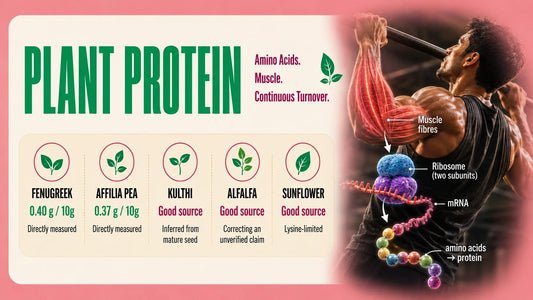
Alongside that, alfalfa carries plant protein, which plays a role in muscle repair, enzyme function and general cell maintenance, the same reason legume seedlings in general draw interest from people building more plant-forward diets. We go through the fuller picture, including how alfalfa compares to Affilia Pea, Fenugreek and Kulthi, in Plant Protein: Role in the Body, Sources & Which Microgreens Have It, our dedicated nutrient deep-dive.
How to Use Alfalfa Microgreens
Alfalfa's delicate texture and mild, faintly sweet flavour make it an easy addition to dishes you're not cooking - it doesn't hold up well to heat, but it's an easy, low-effort way to add a little crunch and colour to something you're already making.
A Quick Growing Note
AgriZen grows every variety the same way, indoors under LED light, watered with RO-purified water, from certified organic seed. We cover that full process, and what the organic-seed certification does and doesn't cover, in How Microgreens Are Grown: From Seed to Harvest.
The one thing that's genuinely different about alfalfa is the seed size. Because it's so small, alfalfa is sown far more densely than most other varieties, which is part of why it's also one of the quickest to reach harvest.
Frequently Asked Questions
What do alfalfa microgreens taste like?
Mild, slightly sweet and faintly nutty, with a gentle crunch. It's one of the more delicate-tasting microgreens AgriZen grows.
Are alfalfa microgreens the same food safety risk as alfalfa sprouts?
No. FDA guidance around raw sprouts, including alfalfa sprouts, is about how sprouts are grown - in warm, humid, enclosed conditions - and eaten whole including the root. Alfalfa microgreens are grown in a medium under light with airflow, and only the above-medium stem and leaves are harvested. The caution FDA gives around sprouts specifically is directed at that growing method, which alfalfa microgreens don't share. Ordinary food safety practice, like refrigerating and eating fresh produce promptly, still applies.
Are alfalfa microgreens 35% protein?
No. That figure comes from the dried alfalfa forage-crop literature, where protein is reported as a percentage of dry weight. Fresh microgreens are mostly water, which changes the arithmetic entirely. A precise fresh-weight protein figure for alfalfa microgreens specifically hasn't been widely published in a form we can confidently cite, which is why we present protein as present rather than quoting that number.
Should I be concerned about saponins in alfalfa?
Not at normal microgreen serving sizes. Alfalfa does contain triterpenoid saponins, which begin accumulating a few days into germination, but composition research on alfalfa seedlings has concluded that levels at the sprout and young microgreen stage are not a food safety concern for humans eating normal amounts. The concern in older literature was primarily about high volumes in animal feed.
Which other AgriZen microgreens pair well with alfalfa?
Within the Legume family, Affilia Pea, Fenugreek and Kulthi share a similar growing profile, though each has a stronger flavour than alfalfa's mild crunch. Alfalfa's delicacy makes it a good pairing with heartier ingredients that need a light finishing touch rather than a bold one.
How long do alfalfa microgreens keep after delivery?
Like any fresh, ready-to-eat leafy product, they're best eaten within a few days of delivery and should be kept refrigerated in the meantime. For the full storage guidance, see How to Store Microgreens at Home to Make Them Last Longer.
A Small, Delicate Addition
Alfalfa is a useful reminder that a shared name doesn't mean a shared product, and that even the things a plant is genuinely known for - protein, saponins - don't always translate directly into the microgreen stage in the way popular sources imply. Grown indoors under LED light on AgriZen's shelving, watered with RO-purified water, and cut fresh to order, alfalfa is one of the mildest, most delicate additions on the menu, best used with a light hand.
Previous
Kulthi Microgreens: Taste, Nutrition & How to Use Them
Next
Oats Microgreens: Taste, Nutrition & How to Use Them