Kulthi Microgreens: Taste, Nutrition & How to Use Them
Kulthi, also known as horse gram, has one of the longer cultivation histories of any legume AgriZen grows. Archaeobotanical evidence places horse gram cultivation in South Asia as far back as roughly 3000 to 2500 BCE, among the older domesticated legumes anywhere in the world. It's also one of the most folklore-heavy legumes in Indian traditional medicine, historically credited with everything from dissolving kidney stones to managing diabetes. We're not going to repeat those specific claims here, the evidence behind most of them doesn't rise to the level of a health claim we're comfortable making, but the tradition is real and worth acknowledging rather than pretending kulthi arrived with no history attached.
Kulthi sits in the Legume family, alongside Affilia Pea, Fenugreek and Alfalfa. This guide covers what kulthi microgreens actually are, what's genuinely in them, and how they fit into a meal. For the basics on what separates a microgreen from a sprout or a baby green in the first place, start with What Are Microgreens? A Complete Guide to Nature's Smallest, Most Concentrated Greens, our reference page for everything else on this blog.
What is a Kulthi Microgreen?
Kulthi microgreens come from Macrotyloma uniflorum, grown widely in dry, drought-prone regions of India as a hardy pulse crop, traditionally cooked as a dal or ground into flour. At the microgreen stage, the leaves are small and tender, with a mild, earthy, faintly nutty flavour similar in spirit to its Legume-family siblings.
Like Affilia Pea and Fenugreek, kulthi's seed has a hard coat, so it's usually soaked for several hours before sowing to even out germination. Grown to microgreen size, it's typically ready in eight to twelve days.
Nutrient Profile
A note on sourcing before the data: peer-reviewed studies specifically on horse gram at the true microgreen stage (first true leaf, photosynthetically active) are scarce. The most reliable figures available are for germinated horse gram sprouts or germinated flour. We're presenting these as sprout-stage data and labelling them accordingly rather than passing them off as microgreen-specific measurements.
On protein: germinated horse gram carries roughly 21.66% protein on a dry weight basis, close to the raw seed's 22.50% (Marimuthu et al., 2013, full study here). On a fresh weight basis in hydrated sprouts, this translates to a lower figure because of water content. Horse gram is documented as comparatively high-protein among common Indian pulse crops even in germinated form.
On polyphenols: germination significantly increases total polyphenol and flavonoid content in horse gram. A 2025 peer-reviewed study comparing germinated versus raw and cooked horse gram found germinated horse gram (HG-G) had significantly higher phenolics, flavonoids and antioxidant activity (full study here). The same direction of change, more phenolics after germination, is supported by a separate bread-fortification study that quantified germinated horse gram flour at 52.33 mg GAE per gram for total phenolics, versus 46.53 mg GAE per gram raw (full study here).
The trypsin inhibitor reduction noted in the post's sourcing (full study here) also accompanies reductions in tannins, phytates and oxalates during germination -- antinutrient compounds that can interfere with iron and zinc absorption. Research on related legumes (green gram, chickpea) has found germination improves iron bioaccessibility by 20 to 62% in those species, supporting the reasonable expectation that horse gram's mineral availability improves at the microgreen stage, even without a horse-gram-specific bioaccessibility measurement to cite directly.
|
Nutrient / Compound |
Level in Kulthi Microgreens |
Also Notable For |
|
Plant Protein |
Good source (dry weight ~21.7% in germinated seed) |
Horse gram ranks comparatively high-protein among Indian pulse crops; note all figures are sprout/germinated data, not microgreen-specific |
|
Polyphenols & Flavonoids |
Increases significantly on germination |
Germination raises total phenolics from ~46 to ~52 mg GAE/g in horse gram (sprout/germinated flour data) |
|
Iron |
Present |
Germination reduces tannins/phytates/oxalates that interfere with absorption; horse-gram-microgreen-specific bioaccessibility not yet measured directly |
|
Zinc |
Present |
Common across Legume family microgreens |
|
Trypsin inhibitors (antinutrient) |
Reduced through germination |
Confirmed by peer-reviewed processing research on horse gram |
Ratings above are qualitative. Protein and polyphenol figures are from germinated horse gram studies rather than true microgreen-stage measurements.
None of this amounts to a claim that kulthi microgreens treat, prevent or manage any named health condition, including the kidney stone, diabetes or weight-related claims that circulate widely around horse gram in traditional and popular sources. They're a nutrient-dense addition to a meal, best eaten as part of a varied diet.
Role in the Body
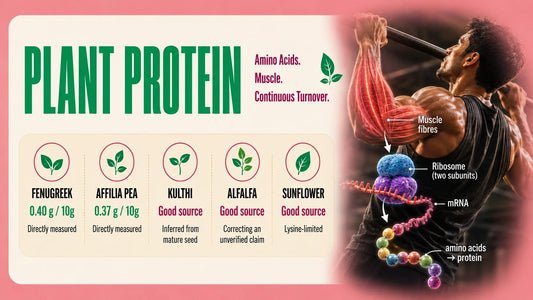
Kulthi is a source of plant protein, which plays a role in muscle repair, enzyme function and general cell maintenance. We go through the fuller picture, including how kulthi compares to Affilia Pea, Fenugreek and Alfalfa, in Plant Protein: Role in the Body, Sources & Which Microgreens Have It, our dedicated nutrient deep-dive.
It also carries iron, central to how the body transports oxygen through the blood, and zinc, involved in immune function and wound healing. We cover both in more depth in Iron: Role in the Body, Sources & Which Microgreens Have It and Zinc: Role in the Body, Sources & Which Microgreens Have It, our dedicated nutrient deep-dives.
How to Use Kulthi Microgreens
Kulthi's mild, earthy flavour fits naturally into the kind of home cooking horse gram has always shown up in, just in microgreen form rather than as a slow-cooked dal.
A Quick Growing Note
AgriZen grows every variety the same way, indoors under LED light, watered with RO-purified water, from certified organic seed. We cover that full process, and what the organic-seed certification does and doesn't cover, in How Microgreens Are Grown: From Seed to Harvest.
Frequently Asked Questions
What do kulthi microgreens taste like?
Mild, earthy and faintly nutty, similar in spirit to Affilia Pea and Fenugreek, though gentler than fenugreek's bitterness.
Is kulthi the same thing as horse gram?
Yes, kulthi is the common Hindi name for horse gram, a pulse widely grown in dry regions of India and known scientifically as Macrotyloma uniflorum.
Does germination change the nutritional profile of horse gram?
Yes, measurably. Germination reduces trypsin inhibitors and other antinutrients that can interfere with protein digestion and mineral absorption, and raises total polyphenol and flavonoid content. The protein content stays comparable to the raw seed. These are among the most well-documented effects of legume germination generally.
Does kulthi or horse gram cure kidney stones or diabetes?
We're not going to make that claim. Horse gram has a long history in traditional Indian medicine for conditions like these, but the scientific evidence behind those specific uses doesn't support treating, preventing or managing any named health condition. Kulthi microgreens are a nutrient-dense food, not a treatment.
Which other AgriZen microgreens pair well with kulthi?
Within the Legume family, Affilia Pea, Fenugreek and Alfalfa share a similar growing profile and a similarly mild-to-earthy flavour range.
How long do kulthi microgreens keep after delivery?
Like any fresh, ready-to-eat leafy product, they're best eaten within a few days of delivery and should be kept refrigerated in the meantime. For the full storage guidance, see How to Store Microgreens at Home to Make Them Last Longer.
A Small, Storied Addition
Kulthi carries more history than almost anything else on this list, and it's possible to respect that history without borrowing its most dramatic claims. Grown indoors under LED light on AgriZen's shelving, watered with RO-purified water, and cut fresh to order, kulthi's mild, earthy flavour is a small, grounded addition to a meal, nothing more and nothing less.
Previous
Affilia Pea Microgreens: Taste, Nutrition & How to Use Them
Next
Alfalfa Microgreens: Taste, Nutrition & How to Use Them